United States · Architecture
ADU Potential Across the United States: Why Backyard Cottages Are Having a Moment (2026)
A source-linked look at accessory dwelling unit (ADU) potential across the US: where states have legalized backyard cottages, how fast permits are growing, what still blocks construction, and how AI design tools help homeowners explore ADU ideas before hiring professionals.
HeyUrban Editorial · AI-assisted, source-linked · November 25, 2026
The quiet boom in backyard homes
An accessory dwelling unit — ADU, backyard cottage, granny flat, casita, or in-law apartment — is a small, self-contained home on the same lot as a primary house, usually with its own kitchen and bathroom. It can be detached in the backyard, attached to the main house, or converted from a garage, basement or attic. Once a niche idea, ADUs have become the most common state-level housing reform in the country: according to the Mercatus Center's 2025 taxonomy of state ADU laws, 18 states have now passed laws broadly allowing homeowners to build and rent out ADUs, and 11 of those states acted within just the past four years.
The numbers behind the shift are striking. Analysis of building permit data by Cotality found that ADU permits rose roughly 1,100% between 2015 and 2025, and ADUs now account for about 7% of all residential construction permits nationwide. In especially expensive cities such as Los Angeles and San Francisco, more ADU permits were issued in 2025 than permits for all other forms of housing combined.
Why demand keeps growing
Household structure is changing faster than housing stock. Census Bureau data show that more than a quarter (27.6%) of occupied US households were one-person households in 2020, up from 7.7% in 1940 — a natural fit for small, independent units near family or work. For homeowners, an ADU can house an aging parent, give an adult child independence, or generate rental income that offsets a mortgage. For cities, ADUs add homes in already-developed neighborhoods without substantially changing their form or character, which is why legalization tends to be popular with planners and the public alike.
Massachusetts offers a recent example of pent-up demand: after the Affordable Homes Act allowed ADUs by right on single-family properties statewide, homeowners in 170 communities filed 844 applications in the first six months of 2025, with at least 550 approved by July 2025.
Legal is not the same as buildable
A state law allowing ADUs does not guarantee a smooth project. An October 2026 report from The Pew Charitable Trusts reviewed zoning codes and found that many local ordinances still contain provisions that make construction slow, expensive or infeasible — owner-occupancy mandates, parking minimums, and discretionary permit requirements are the recurring culprits. The practical takeaway for any homeowner: state law sets the ceiling, but your city or county's specific ordinance, lot coverage rules, setbacks, utility connection fees and permitting process decide what is actually possible on your lot.
Costs vary widely by region and design, and every ADU still needs to meet building, energy, and accessibility codes like any other home. Treat any early concept as a starting point for conversation with your local building department and licensed professionals — not as a permit-ready plan.
Where the potential is greatest
ADU potential concentrates where three things overlap: high housing costs, large stocks of single-family lots, and recently reformed state law. California remains the clearest example, with Los Angeles and San Francisco issuing more ADU permits than all other housing types combined in 2025. The Pacific Northwest built an early lead, and the Mercatus taxonomy shows the reform wave spreading inland and to the East Coast — 11 of the 18 broadly-legal states adopted their laws in the last four years, with bills introduced in several more.
For homeowners in newly-legal states, the opportunity is real but the playbook is still being written: local departments are adapting processes, lenders are developing ADU-specific products, and neighbors are learning what a well-designed backyard cottage looks like. Early movers who design thoughtfully — matching the main house, respecting privacy, and planning for light and landscaping — set the tone for their blocks.
Exploring your ADU idea with AI design tools
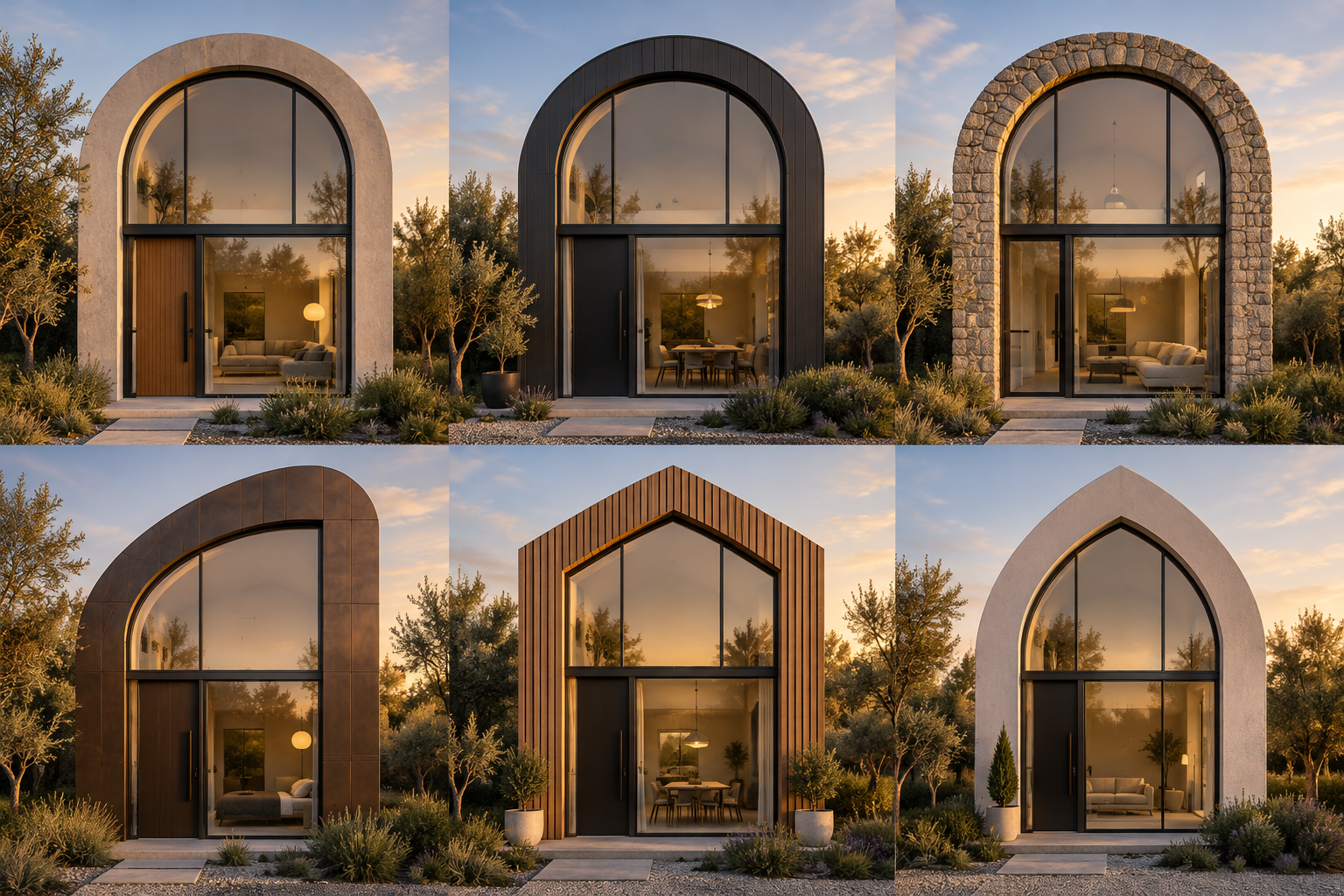
The earliest stage of an ADU project is visual: what could a small home look like on this lot, in this light, behind this house? This is where AI design tools genuinely help. On HeyUrban, you can generate exterior concepts for small arched cottages, modern studios or garden suites in minutes, explore interior layouts with a living area, kitchen, bathroom and bedroom, and produce conceptual 2D drawings to discuss with family, designers or contractors. The concepts in this article's image — six arched ADU cottages in stone, dark metal, timber and stucco — were AI-generated to show the range of directions a small backyard home can take.
One honest boundary, stated plainly: AI renderings are concepts, not construction documents. They cannot establish exact dimensions, and no image replaces a site survey, a measured plan, or your local building department's review. Use AI to explore and communicate ideas quickly — then bring in licensed professionals to make the chosen design real, code-compliant and permittable.
Sources & further reading
- 1. A Taxonomy of State Accessory Dwelling Unit Laws 2025 — Mercatus Center(2025-08-01)
- 2. Building backyard value with ADUs — Cotality(2026-07-01)
- 3. Accessory Dwelling Units Can Meaningfully Boost Housing Supply — The Pew Charitable Trusts(2026-10-21)
- 4. ADU applications surge statewide under Governor Healey's Affordable Homes Act — Mass.gov(2025-09-26)
- 5. Dwelling on it: ADUs advance on the coasts and inland — Pacific Research Institute(2025-06-05)